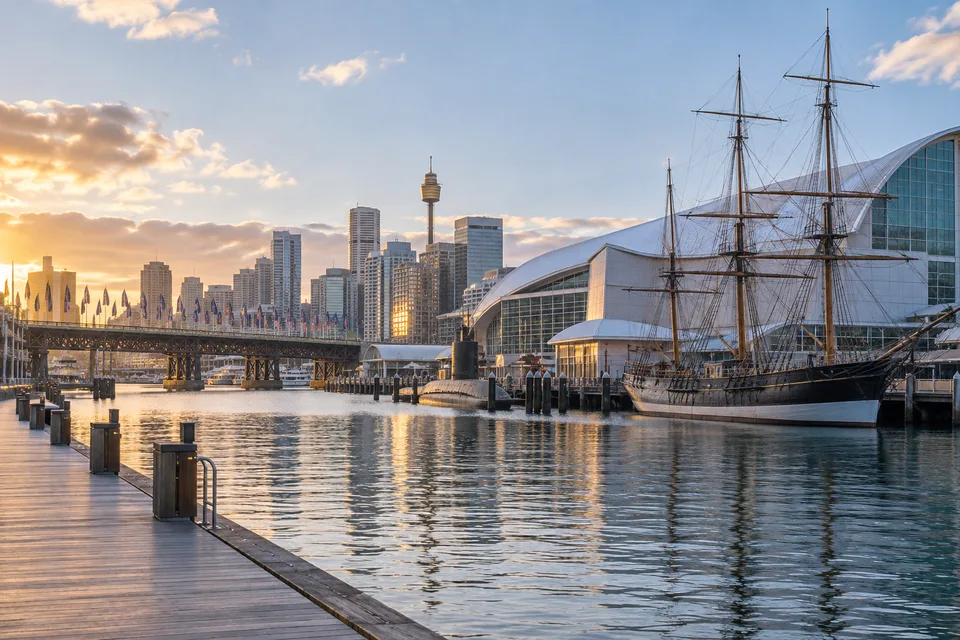
The Australian National Maritime Museum gives Darling Harbour a different kind of waterfront stop: one where the harbour is not just a view, but the setting for stories told through vessels, galleries, artefacts and research. At 2 Murray Street, next to Pyrmont Bridge, the museum brings together public spaces on the water with collections that trace Australia’s connections to oceans, rivers and maritime neighbours. It is a useful choice for a visitor who wants a cultural attraction with a clear sense of place in central Sydney.
Start with the waterfront
The museum’s visitor guidance invites people to walk the waterfront, explore galleries and board selected vessels. HMB Endeavour and the submarine HMAS Onslow are named among the experiences, placing the visit at the intersection of exploration, naval history and the practical engineering of life at sea. Vessel access can change, however, so it is sensible to check current availability before setting out, especially when a particular vessel is central to the plan.
The standard published opening hours are daily from 10am to 4pm, with final standard vessel boarding at 3:10pm; the museum is closed on Christmas Day. Those timings make arrival time worth considering. Visitors interested in both the galleries and vessels should consult the museum’s current information before travelling, rather than assuming that a particular route or area will be available on the day.
Follow a question through the collections
A strong way to approach the museum is to choose a question before entering. The museum’s published research and interpretation ranges across First Nations, migration, maritime archaeology, ocean futures, Australia’s Indo-Pacific connections, and society and water. That breadth means a visit can move from the material evidence of a shipwreck to stories of migration, or from the sea as a working environment to the environmental challenges facing oceans and waterways.
The First Nations material is presented by the museum as a keeping place for conversations with community relating to exhibitions, research and programmes that embrace Aboriginal and Torres Strait Islander cultures. For visitors, that is a reason to follow the museum’s own context and guidance closely. It also makes clear that maritime stories are not limited to ships: they include Country, community knowledge and continuing relationships with water.
Make room for ships and galleries
The museum describes its galleries and historical artefacts as a way to explore Australia’s deep connection to the sea, past and present. Pairing an indoor gallery with a waterfront vessel creates a useful contrast. One part of the visit can focus on objects and interpretation; another can focus on the scale, layout and working realities suggested by a ship or submarine. Let the current map and visitor information decide the sequence, particularly if a vessel is unavailable.
For a visitor already walking through Darling Harbour, the location beside Pyrmont Bridge makes the museum easy to combine with surrounding city time. The museum advises that it can be reached on foot, by car, train, bus, ferry or light rail, and directs travellers to Transport for NSW for a route from their starting point. That is a practical prompt to plan the journey around the current transport network rather than treating one mode as the only option.
Leave with a wider view of water
The best reason to visit is the museum’s ability to connect a harbour-side experience with a wider set of questions. Its work on migration, archaeology, ocean futures and regional connections gives the waterfront exhibits context beyond their physical presence. Whether the day centres on a vessel, a gallery or a particular research theme, a focused visit leaves space to consider how waterways have shaped movement, work, memory and exchange across Australia.
Sources
Sources last validated: 14 September 2026.