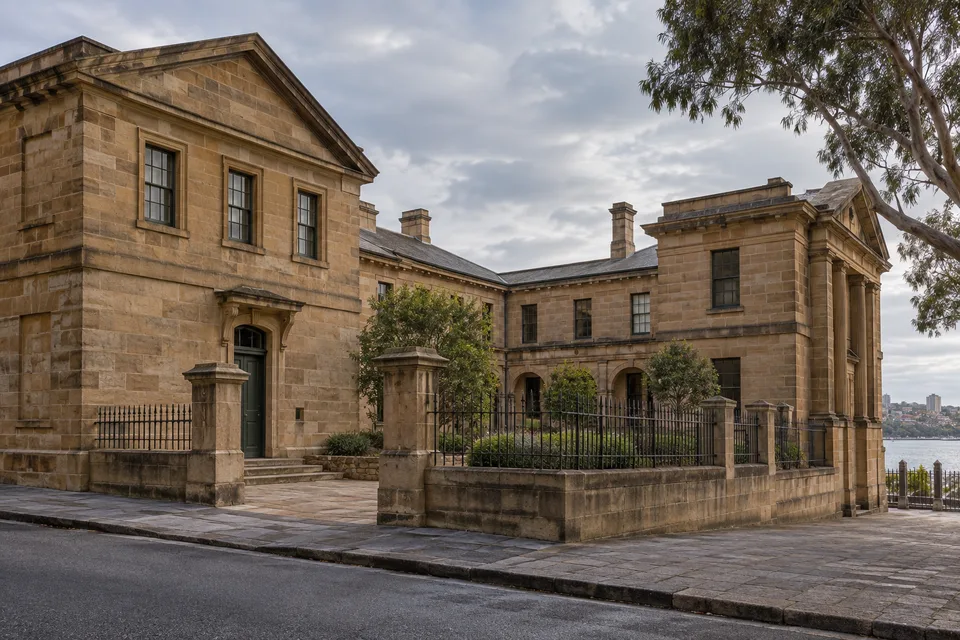
Justice & Police Museum sits at the corner of Albert and Phillip streets on Gadigal Country, in buildings that once formed part of a busy legal hub. Museums of History NSW acknowledges the impact that colonial and state law-enforcement policies and actions have had on First Nations people, communities and culture, and notes that their stories and perspectives have not always been well represented or heard. That acknowledgement gives a necessary starting point for a visit concerned with the history of justice, rather than simply its spectacle.
A former legal hub by the harbour
The complex includes the former Water Police Station, Water Police Court and Police Court. Museums of History NSW describes the waterfront as a place where misadventure and misdemeanour have long intersected with the growth of Sydney. The location helps explain why policing and courts operated here: the harbour was central to a city that expanded outward from its shore, and the buildings preserve the institutional side of that story.
The museum’s public description reaches from bushrangers and razor gangs to the future of forensics, but the visit is stronger when approached as a history of systems as well as individual cases. Police, courts, defendants, witnesses and communities all appear in the museum’s subject matter. The former station and courtrooms provide a physical framework for considering how law was enforced, challenged and experienced in Sydney.
Look beyond the crime story
The museum’s collection and interpretation offer an opportunity to move beyond a simple divide between ‘crooks’ and ‘cops’. Museums of History NSW describes stories here as belonging to locals and drifters, the guilty and the innocent, as well as police and judges. Those categories can be useful entry points, but the historic setting also prompts more difficult questions about who had power, whose testimony was heard and how law-enforcement institutions shaped everyday life.
A permanent display on Alexander Riley, a legendary Aboriginal police tracker, is part of the current offering. The museum says the display features the remarkable talents of Aboriginal trackers who worked for NSW Police in the 20th century. Read alongside the site’s Gadigal Country acknowledgement, it provides a particular reason not to flatten First Nations histories into a supporting detail of policing history. Allow the display and the museum’s own interpretation to guide the way that material is considered.
Use the rooms as evidence
Former courtrooms and a police station are not neutral backdrops. They make visible the spaces in which procedures, authority and consequences were organised. Museums of History NSW notes that the complex was once one of the colony’s busiest legal hubs, and its stories describe additions and improvements as evidence of changing functions over time. Take time to notice the relationship between the connected buildings rather than looking only for a single object or notorious name.
The museum also frames the site as a place for reflection and conversation about historical and modern experiences of First Nations people and the justice system. That makes careful reading especially important. A visit need not arrive at a quick conclusion; its value lies in encountering archival, architectural and institutional evidence that complicates familiar stories of Sydney crime and policing.
Plan a weekend visit
The Justice & Police Museum is at the corner of Albert and Phillip streets, Sydney. Its current published hours are Saturday and Sunday, 10am to 5pm, with closures on Good Friday and Christmas Day. The visitor information identifies wheelchair access. Check the museum’s official page before travelling, particularly if an event, programme or a particular access requirement is important to the visit, because practical arrangements can change.
No ticketing condition, price or programme availability is assumed here beyond the current official visitor information. Give the place time to be more than a stop on a crime-themed itinerary. The former Water Police Station and courts, the current display on Alexander Riley and the museum’s explicit invitation to reflect provide a fuller way to encounter Sydney’s legal past.
Sources
Sources last validated: 14 September 2026.